TILLSAMMANS is unsolicited architecture.
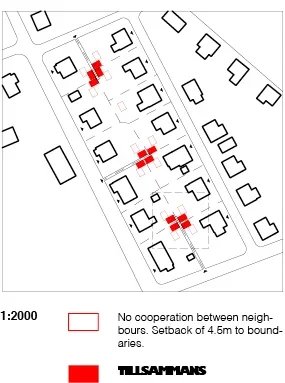
TILLSAMMANS builds upon a rich history of communal and cooperative housing in Sweden, and simultaneously takes advantage of the recently introduced Attefallshus planning regulations. The new regulation allows for the building of a small dwelling without planning approval provided the structure has a footprint less than 25 sq. and is less than 4m high to the ridgeline. Setbacks from neighbouring boundaries are to be 4.5m unless prior agreement has been sought with the neighboring properties. Via this clause the Attefallshus may be built as close to neighboring boundaries as wished. It is this ’loophole’ that TILLSAMMANS looks to take advantage of.
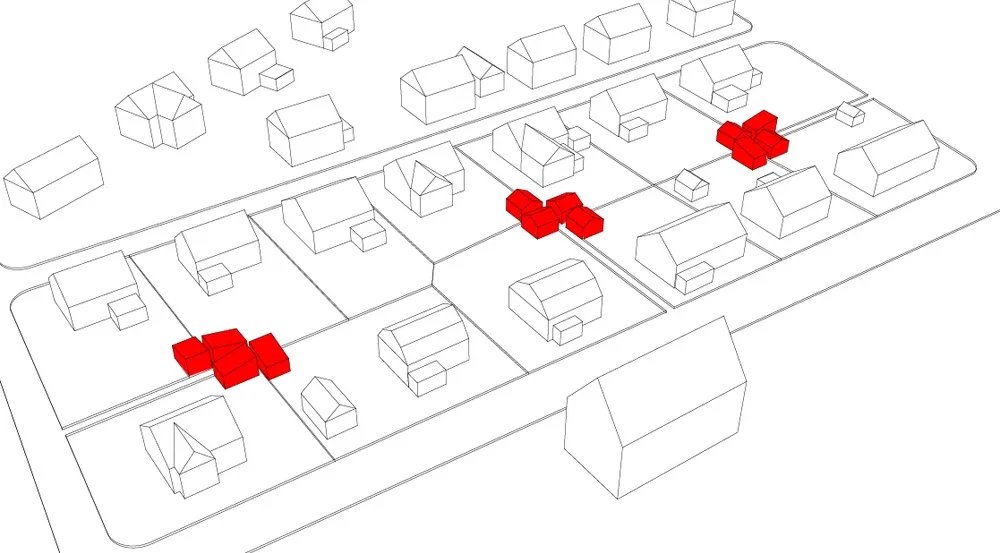
By exploiting this clause a group of neighbors with adjacent or interlocking boundaries can form ’co-ops’, each building their own Attefallshus within the regulations that when combined form a new small scale suburban communal living form. The small units, affordable and easily pre-fabricated, are ideal for students, grown children or couples with compact living arrangements looking to move closer to the city.
The TILLSAMMANS concept rewards cooperation between neighbors and small sacrifices of land with attractive and affordably-built rental units in a currently booming housing market. Stockholm is currently facing a severe housing shortage, with 100 000 apartments required in the next 15 years. So far solutions have focused on increasing density via high-rise apartment blocks, often using parts of Stockholms much-loved inner-city green spaces. These solutions have proved controversial as they compromise what many see as the essence of Stockholm, the ability to access nature within minutes no matter where one lives.
TILLSAMMANS looks instead to Stockholm’s currently low-density inner suburbs, aiding the housing crisis through small scale suburban interventions into the existing single-family housing patterns. It is groundbreaking in that it would allow the shortage to be taken up through a process outside the normal planning approval system, that is that economic and social incentives would drive owners to take advantage of the new system without state intervention. This would take pressure off large-scale expensive state supported high-rise solutions with lengthy approval processes. As long as the TILLSAMMANS system is built within the regulations, there is no further public consultation process. Stockholms much-vaunted green spaces would remain intact.
We have taken 3 typical suburban configurations in the Stockholm area, all within a 15km radius of the city centre (T-Centralen). All have good access to public transport and offer a travel time of 30min to the centre. Housing types represented are typical Stockholm ’villas’ or single family dwellings with lot sizes ranging from 35m deep to 55m deep. Houses are typically of modest scale and of similar character, with traditional building materials and colours, steeply pitched roofs and well kept gardens.
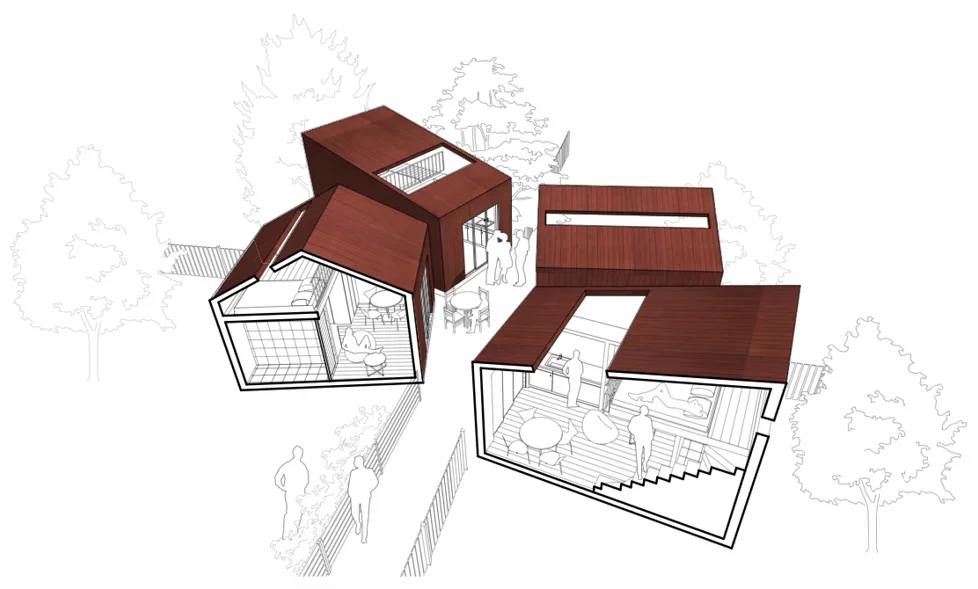
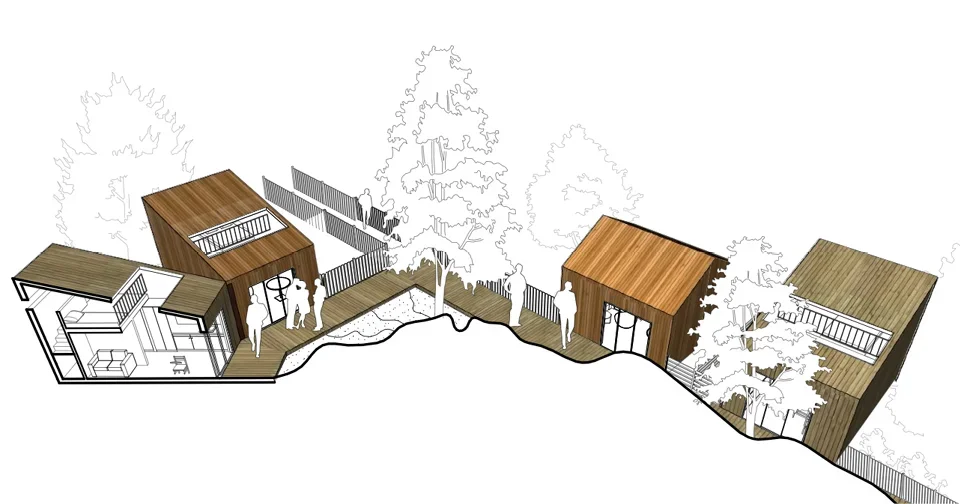
By exploiting the full 25sqm footprint with the 4m height limit, upwards of 35sqm of living space can be designed, with low-height bedroom lofts allowing the whole entry floor to be given over to an open-plan living, dining and kitchen with compact bathrooms. Pitched roof forms allow the units to be camouflaged in their local contexts, appearing as just another garden shed.
TILLSAMMANS has the potential to be the next enviable Scandinavian housing model, a test-bed for an innovative solution to a problem being faced the world over. What makes it all the more achievable in Stockholm is that unlike many other countries, the city has a long history of alternative communal living arrangements, whether they be 2 family homes, co-housing systems, ’living hotels’ or standard cooperatives. This spirit of cooperation and collaboration is perhaps the key to solving the city’s current housing shortage in a sustainable and low-impact way which maintains its much-loved green spaces.
The answer is in the suburbs.
The next case study looks at the south west suburb of Malarhojden, and in particular those lots backing onto the old tram line, which now acts as a long green river of stateowned parkland. This study provides a model for other areas sharing a boundary with one of Stockholms green spaces. This form requires not only a potential cooperation between neighbours but also an agreement with the local council to front onto and provide access directly.
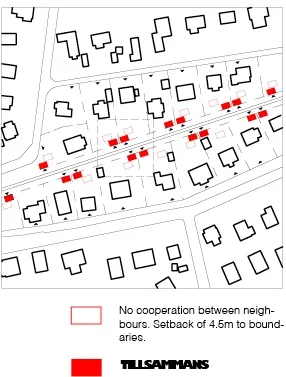
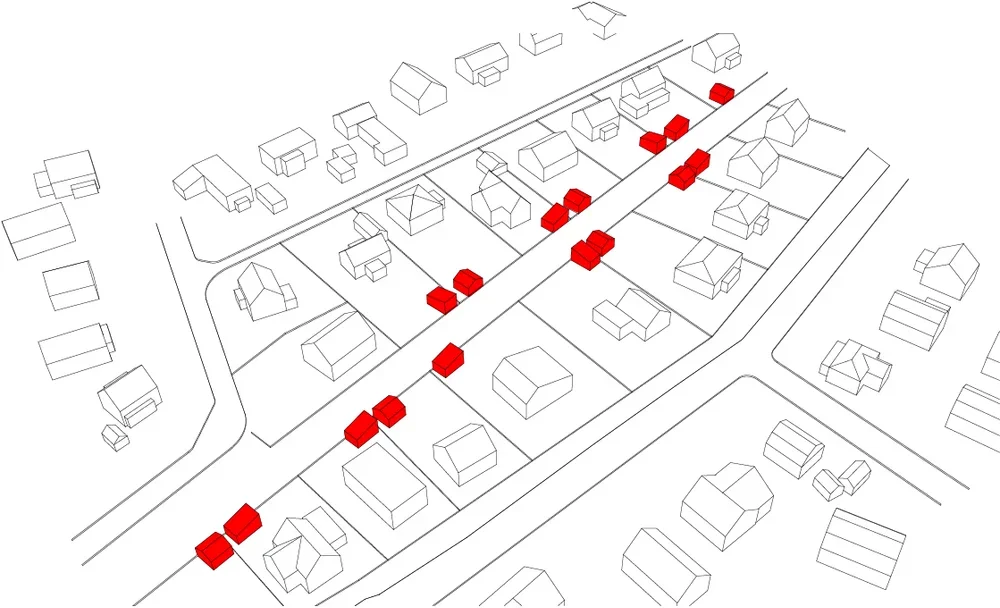
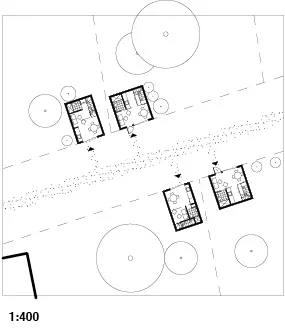
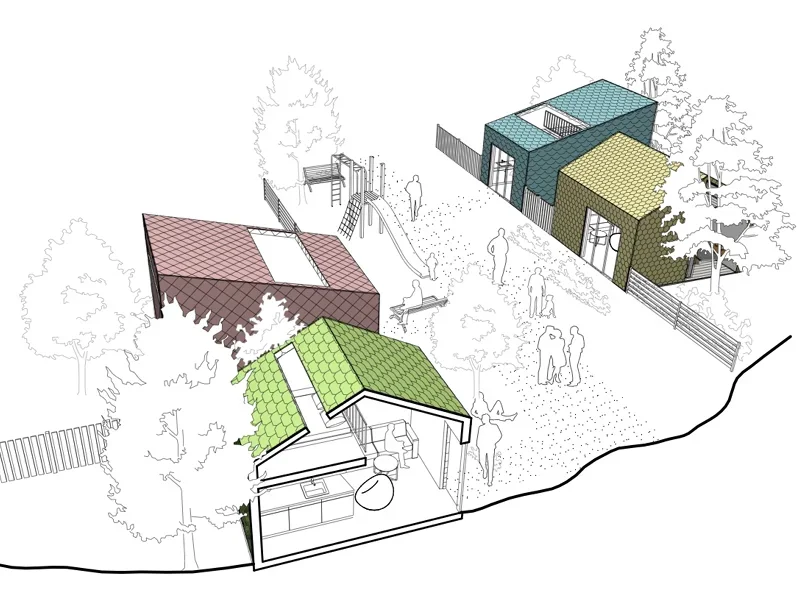
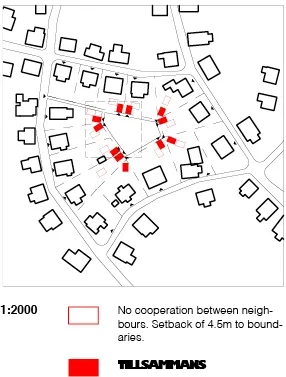
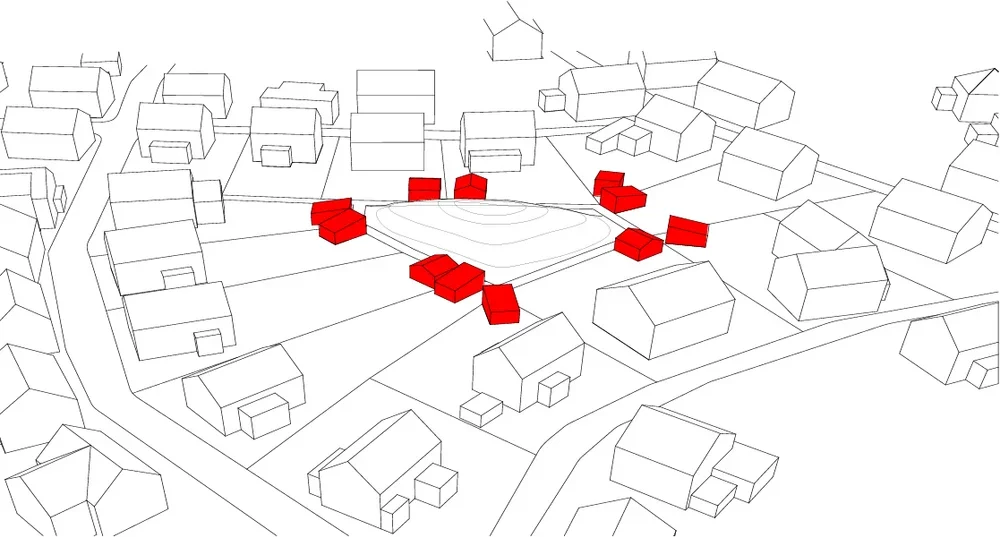
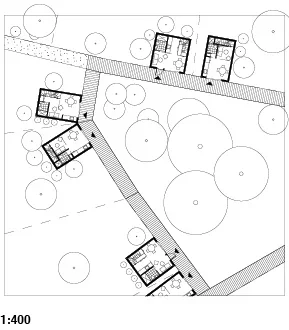
The final case study looks at a standard block in Bromma, organised around a wooded rocky outcrop normally unsuitable for building. These blocks are endemic to Stockholm and occur right around the city. The study examines the idea that these natural ‘voids’ within the block could be exploited to provide access to a series of Attefallshus at the rear of their respective lots fronting onto the outcrop, which is generally state land.
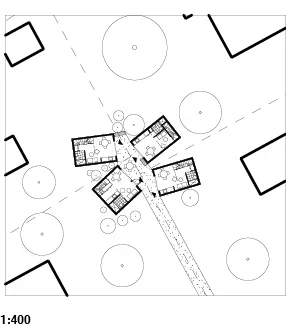
The first study looks at the suburb of Alvsjo south of Stockholm, characterised by a regular grid arrangement of lots unimpeded by natural rock outcrops like so much of the city. The uniformity of the standard block makes it perfect for the TILLSAMMANS concept. With 4 lots of similar size sharing a common corner boundary point, there is an opportunity to build an Attefallshus on the corner of each lot, forming a small-scale ‘village’ intervention within the typical block. Access and address is provided by a slender pathway from the nearest street, with rights to the pathway agreed by the 2 neighbours concerned.