The Stockholm Salon
Salon Session #1 - The Aesthetics of Sustainability
(Beauty, pleasure, and responsibility)
Background
The Original “Salon” Structure came from the Blue Stockings (18th-century England), here we have thrown it in with some existentialism from Sartre/Beauvoir.
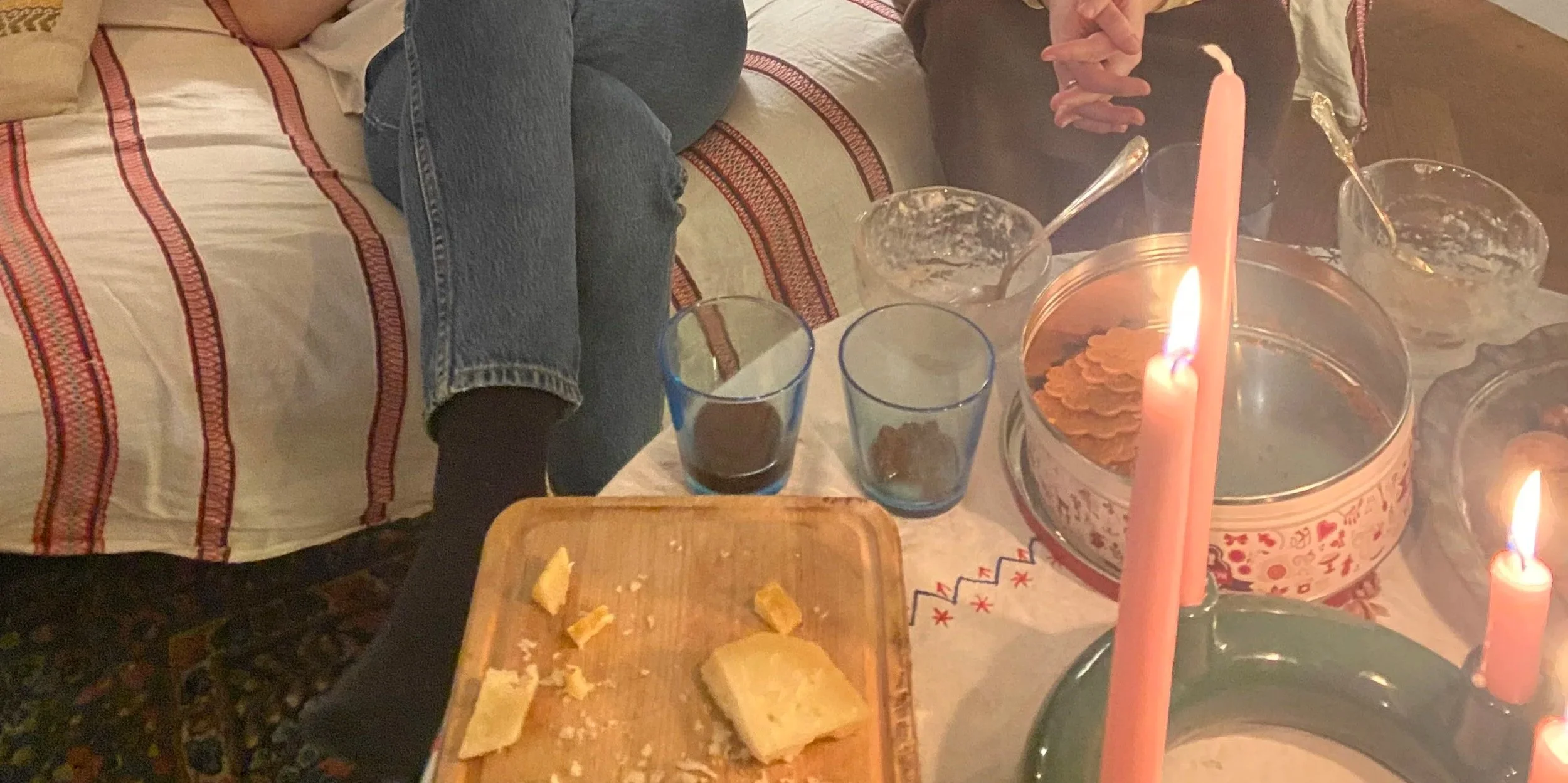
The setting is a gathering in the Old Town in Stockholm, just before Christmas. The focus is on conversation, reading, and critique of new writing or philosophical ideas. Semi-structured with the host starting off reading a letter, essay, or literature summary aloud, then open the floor to discussion.
Preamble
“To do nothing is to hold open a space in which something else can happen.”(Jenny Odell)
To live aesthetically may simply mean to remain long enough with one question to see it unfold.
This sessions question is not whether the concept of sustainability works (one might say it isn’t), but how it appears, how it is felt, and how it shapes our capacity to think and act together.
Though 1:
Through Hannah Arendt we are told the world isn’t just the natural environment, but the shared space of appearance. A place where things, actions, and words are seen, judged, and remembered.
From an existentialists point of view, participation is existential. Sartre means that we define ourselves through what we choose to support, enjoy, or ignore.
Do we pursue sustainability to feel virtuous?
To belong to a cultural elite?
To preserve comfort?
Or to take responsibility for the future in accordance with the Brundtland commission: "Sustainable development is development that meets the needs of the present without compromising the ability of future generations to meet their own needs.” Is that relevant and what does it actually mean with “needs” ?
Thought 2:
Hélène Frichot’s Dirty Theory offers a counterpoint to smooth, resolved narratives of sustainability. She proposes theory as something entangled, situated, embodied. Dirty theory resists purity. It stays with mess, friction, unfinishedness. It refuses the fantasy of total solutions. Sustainable aesthetics, from this view, should not reassure us too quickly. It should trouble us.
Additionally RemKoolhaas reminds us that architecture and design does not operate outside global systems of power, logistics, and economics. Aesthetic calm must not mask violent logistics elsewhere. Sustainability must be allowed to look unresolved, conflicted, even uncomfortable, if it is to remain honest. With this in mind he chose to focus on the countryside in the exhibition “Countryside, the future” as an antidote to the urban hyper focus and the extractive nature of cities vis-a-vis the countryside. To bring it close to home you could say that “Stockholm is growing, because Kiruna is moving”.
Put this in opposition to Bjarke Ingels catch phrase of “Hedonistic Sustainability”, in which he want to push for sustainability to be enjoyable. Sustainability should not be about sacrifice but about enhancing human experiences. This would align well with the psychological theory that human conduct is influenced by the desire to experience more pleasure and experience less suffering and to make lasting change you need to lean into this. There is optimism here, but also a risk. Hedonism, after all, has a history of exclusion. Is beauty then a gateway to sustainable behaviour, or a distraction from deeper change?
Attention as method
Attention requires time.
Time requires resistance to urgency.
And resistance to urgency, as Odell suggests, creates space for other things to emerge.
To live aesthetically — and sustainably — may mean to hold questions open long enough for something else to emerge.
Questions:
How do we engage with sustainability ?
Through guilt or desire?
Through restraint or pleasure?
Through purity or contradiction?
Closing:
“Only the existence of a public realm and the world’s subsequent transformation into a community of things which gathers men together and relates them to each other depends entirely on permanence. If the world is to contain a public space, it cannot be erected for one generation and planned for the living only; it must transcend the life-span of mortal men.” (Hannah Arendt, The Human Condition)
Proposed loose structure for the Salon Session:
1. The host opens the floor and reads a summary of ideas based on selected books.
2. Everyone gets 2 minutes (max) to mention something that resonated with them from the reading
and to mention one object/place that is “sustainably beautiful” to them.
3. Time for open conversation.
4. One person summarise what felt most present in the conversation and if there are specific questions that came out of it.
Inspirational texts
Jenny Odell - How to Do Nothing
Hannah Arendt - The Human Condition
Rem Koolhaas - Countryside: The Future